- Case Study
- Kalyani Technoforge

Differential Case Assembly Line
Smarter assembly for a faster future
How our integrated automation solutions improved Kalyani Technoforge’s productivity and product quality
- JENDAMARK DELIVERED
- Pune, India
About the Customer
Established in 1979, Kalyani Technoforge (KTFL) has become known as one of India’s most dependable and consistent manufacturers of forgings. The company’s state-of-the-art manufacturing plants across the country specialise in products like hot and cold forging, aluminium forging, high-speed forging, precision machining, and gear cutting for domestic and international customers.
KTFL enlisted Jendamark India to integrate new automation solutions into an existing differential case assembly line to improve production speed, efficiency and quality.
Key Challenges
The assembly line’s current rate of production was unable to meet the growing customer demand.
- Challenge 1
Optimising manpower requirements:
KTFL aimed to optimise the manpower required on the assembly line by evaluating automation opportunities, streamlining workflows, and leveraging smart manufacturing technologies to maintain productivity.
- Challenge 2
Integrating a third-party gauging machine:
Risk factors associated with integrating the new machine included:
- Communication protocol mismatch
- Mechanical alignment
- Data integration
- Operator training
- Downtime during installation
- Challenge 3
Operator fatigue:
The manual transfer of heavy differential assemblies between workstations increased operator fatigue, resulting in ergonomic risks and reduced efficiency. These labour-intensive, repetitive tasks slowed the operator’s workflow, reducing throughput, and increasing physical strain, especially during long shifts.
- Challenge 4
Variable manual processes:
Manual processes in the current assembly workflow were slowing production and introducing variability in quality.
- Uneven sealant dispensing:
The existing manual method led to inconsistent application – some joints received too much sealant, causing mess and rework, while others received too little, creating quality concerns. - Manual bolt tightening:
Operators used handheld tools, which vary in torque accuracy and speed. This not only increased the cycle time but also raised the risk of under- or over-tightening, affecting product reliability.
Our Solution
- Solution 1
Collaborative robot:
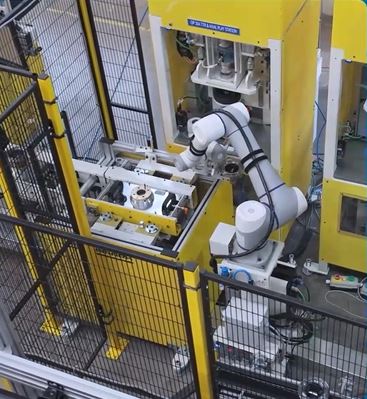
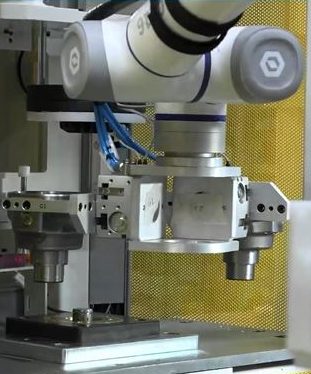
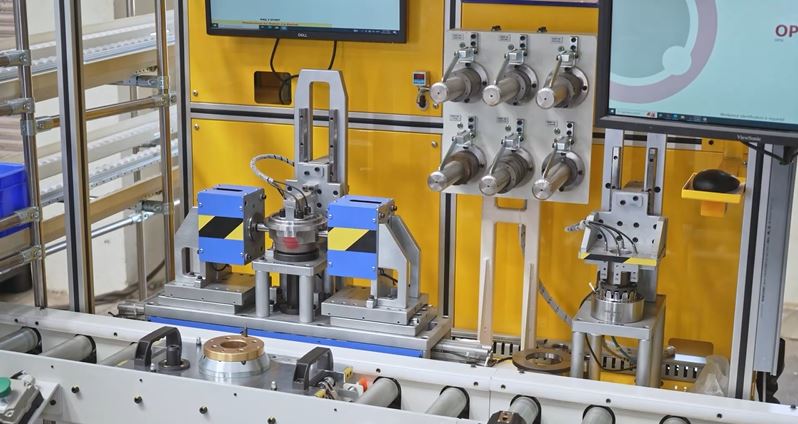
To optimise manpower on the production line, Jendamark integrated the DOBOT collaborative robot (cobot) into the assembly process to automate repetitive, labour-intensive tasks. Automating the handling of differential assemblies between three workstations reduced reliance on manual labour, enhanced consistency, shortened cycle time, and improved overall production efficiency. Its compact design and user-friendly programming make it a flexible and cost-effective automation solution, well-suited for deployment across multiple points on the assembly line.
- Solution 2
Integration of the third-party gauging machine:
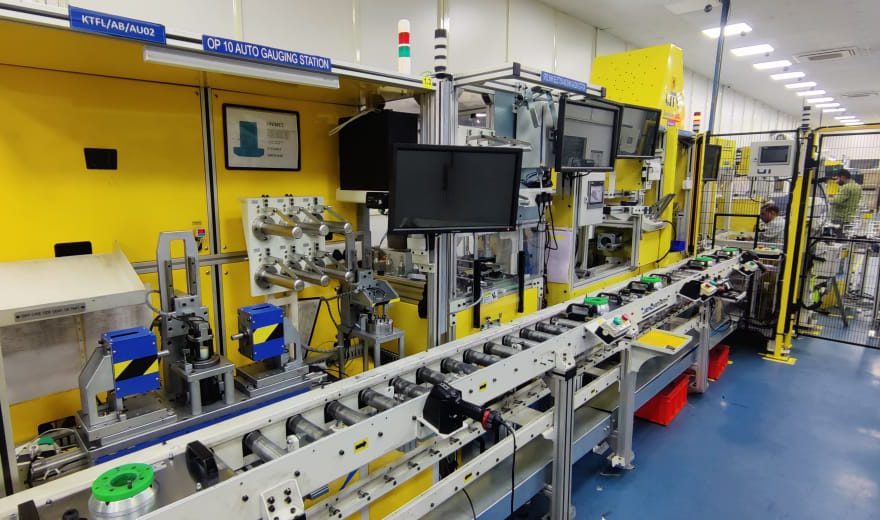
Jendamark successfully integrated the third-party gauging machine to be fully compatible with the existing production line.
- A custom interface solution was deployed to facilitate reliable data exchange between the new equipment and the line control infrastructure.
- The gauging machine’s LVDT probes were used to measure certain values on the gear. ODIN Workstation retrieved this stored data, which was used to calculate correct shim size.
- Custom brackets and alignment guides were designed and installed to ensure proper mechanical fit with the conveyor system.
- Operator training sessions were conducted, supported by translated manuals and hands-on workshops from the machine supplier.
- A staggered installation and dry-run testing approach minimised the risk of downtime, allowing production to resume on schedule.
- Solution 3
Motorised conveyor to reduce operator fatigue:
Jendamark introduced a motorised conveyor system to transfer components between workstations, reducing physical strain and the risk of operator injuries. The conveyor system enhanced line efficiency by ensuring smooth, consistent, and timely part movement. As a result, operator fatigue was significantly reduced, overall morale improved, and productivity increased due to a less labour-intensive workflow.
- Solution 4
Automated sealant dispensing and bolt tightening:
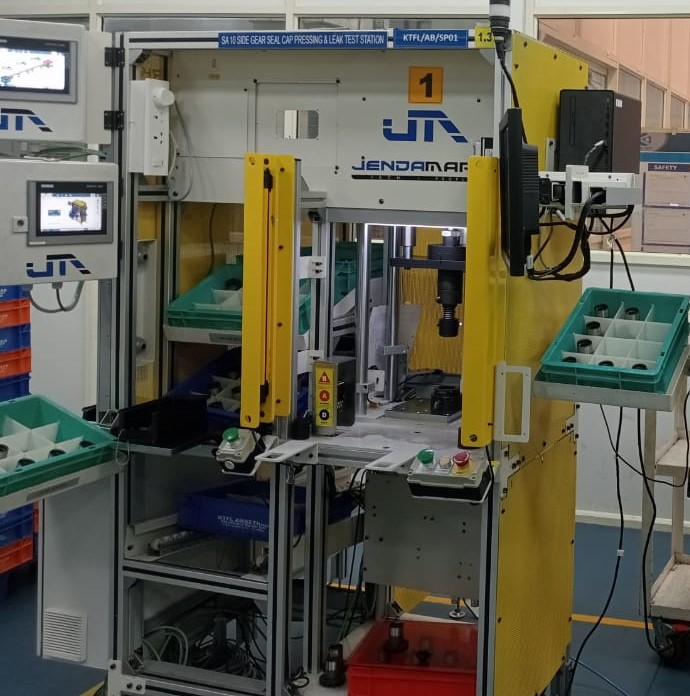
A Selective Compliance Assembly Robot Arm (SCARA) was integrated into the line to ensure:
- precise and consistent sealant application with exact volume control and repeatable paths
- fast and accurate bolt tightening with programmable torque settings.
This automation significantly reduced cycle time, minimised rework, and freed up operators to focus on quality control and value-added activities, improving both efficiency and job satisfaction.
Customer Benefits
Integrating a trio of automation solutions – the DOBOT cobot, third-party machine, and SCARA robot – delivered several measurable benefits:
- Increased production efficiency
- Automating repetitive tasks significantly reduced cycle times across stations.
- Coordinated flow between workstations ensured higher throughput and fewer bottlenecks, resulting in faster order fulfilment and reduced lead times.
- Improved product quality and consistency
- Automated sealant dispensing and torque-controlled bolt tightening ensured consistent assembly quality and more reliable products.
- Reduced human error led to fewer defects and warranty claims.
- Faster and more reliable delivery
- Smart integration enhanced line efficiency, while staged rollouts minimised downtime.
- Improved Overall Equipment Effectiveness (OEE) translated into on-time delivery of customer orders.
- Cost optimisation
- Lower labour and operational costs contributed to more competitive pricing.
- Fewer reworks and quality issues reduced hidden costs associated with returns or field repairs.
- Greater flexibility and scalability
- Modular design of the DOBOT and SCARA systems allows quick reprogramming or relocation for new product variants or process changes.
- The line is agile enough to adapt to changing production volumes or custom orders.
- Enhanced traceability and data visibility
- Integrated machines share data with ODIN Workstation systems, improving traceability and real-time monitoring.
- Customers in regulated industries (e.g., automotive, aerospace) gain from better compliance and documentation.
- Increased operator safety and satisfaction
- Ergonomically challenging tasks are now automated, reducing injuries.
- Operators can focus on value-added and supervisory tasks, improving job satisfaction and retention.
Key Takeaways
The strategic integration of automation technologies has transformed KTFL’s production line into a more efficient, reliable, and scalable operation. By reducing manual intervention, improving process consistency, and minimising downtime, KTFL has been able to optimise internal performance and deliver higher quality products faster and at more competitive pricing – strengthening customer satisfaction and trust.