

So, what really drives a smart factory? The difference may lie in the dashboard – and, more importantly, what lies beneath, as Yanesh Naidoo explores in this article.
In our experience, the core issue is that, while dashboards are great for real-time visibility for better decision-making, they only describe your production – they don’t actually drive anything. (Your assembly line still works the way it did the day it was commissioned.)
If we go back to the 2010s, around the same time that the smart factory revolution kicked off, a parallel movement was happening in the development of smarter cars – on a different kind of dashboard. But one entrant changed the game – and set the direction for where we think smart factories should be headed.
One of the first things that OEMs did was to make their cars appear smarter by adding infotainment screens to their dashboard panel. This standardised smartphone integration, and allowed drivers to connect via Apple CarPlay or Android Auto to play music or use their phone’s GPS navigation system.
But while this was useful for a smoother journey, it once again didn’t drive anything.
One new entrant to the market, however, understood that winning this race would require them to not just add a digital layer on top but to change the actual architecture of the vehicle from the ground up, building it for adaptability and responsiveness to technology.
What the Tesla team created was more than just an electric vehicle, but rather a revolutionary, software-defined vehicle. In essence, they separated the vehicle’s hardware and software, creating two different product development cycles.
Today, this means that Tesla owners can continue to buy and download over-the-air updates and features like window wiper sensors or even autonomous driving capabilities long after they have purchased their vehicle. This helps keep that ‘new car’ feeling, even though the same old hardware is sitting in the driveway.
For Tesla, this also created added production benefits like far less variance on assembly lines, with a few fixed models, and new features added via software, significantly reducing supply chain complexities.
So, what can we learn from this software-defined model when it comes to making assembly lines really smart?
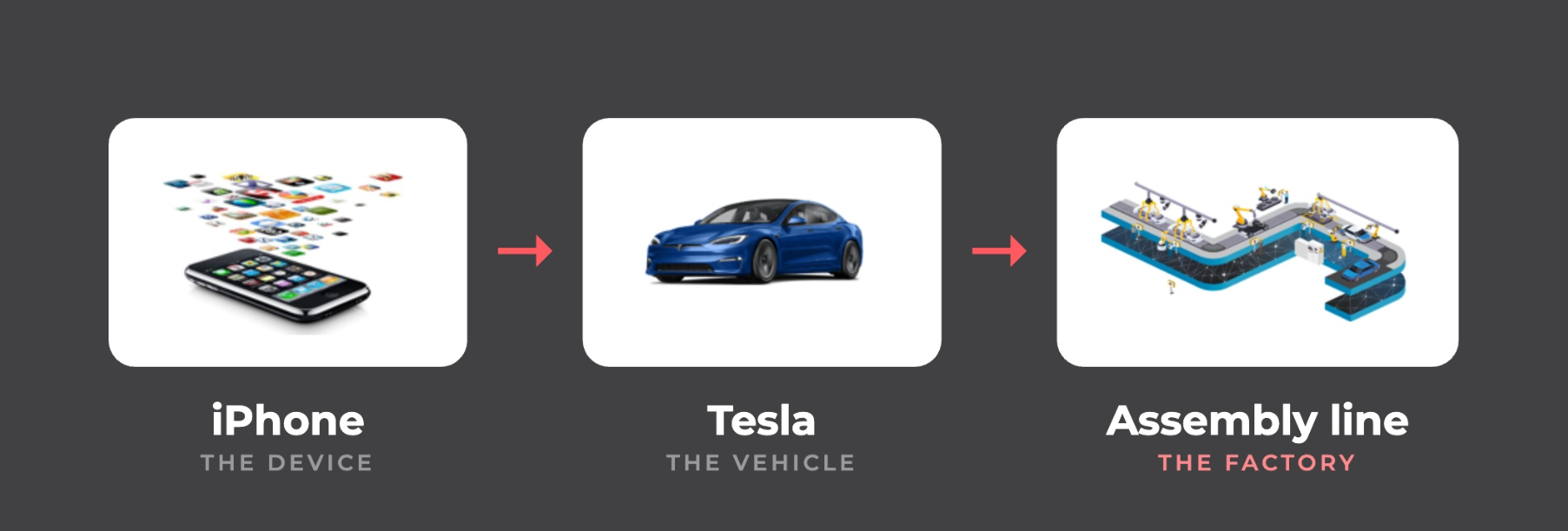
Let’s break down five key traits that reframed the smart car and are now also remaking the factory.
1) Continuous evolution and over-the-air updates
Just like your Tesla can be updated just standing in the garage, in a smart factory a no-code web-based interface allows process engineers to make live process changes without the expense and shutdown window involved in reprogramming PLCs.
2) Accelerated development
In software-defined scenarios, where hardware and software run along parallel tracks, the product can evolve rapidly, as the software leads new feature development and isn’t dependent on halting production to replace or update hardware.
3) Radical cuts in complexity and cost
Traditionally, what cars and production lines have in common is that they are made up of a clutter of disconnected systems that are separately controlled. In the case of a traditional vehicle, which is a hardware-defined production scenario, the features are enabled by multiple black box controllers, each owned by a different Tier 1 supplier. A typical vehicle might have over a hundred separate electrical control units for all the features.
Similarly, a typical assembly line needs to coordinate and control multiple functions, from worker guidance systems to computer vision that tracks the position of different pieces of equipment, quality reporting, and supporting shopfloors processes like maintenance. All these systems are strung together piecemeal to build a system that runs that production line. But there are often gaps between these systems, which creates an unreliable foundation for layering complex analytical systems on top of them.
In the ideal software-defined factory, where one platform replaces fragmented and siloed control, the data can be centralised, whether it be product, process or quality data. This complete data model immediately becomes more valuable and useful for continuous improvement because it is based on learnings from the actual performance of the line.
4) Big data and predictive diagnostics
In a smart car, streaming operational data to the cloud allows monitoring of the real-time health of the vehicle, so that problems can be addressed before you find yourself stranded roadside. Similarly, on a factory floor, live data can be sent to predictive models that analyse downward trends and catch problems before they stop production.
5) Foundation for autonomy and AI
This architecture all lays the foundation for adding AI features in the future, and the same computer brain that enables self-driving in a vehicle will also drive autonomous manufacturing and what we call the ‘self-healing factory’, which makes incremental improvements based on performance data.
[Download the software-defined thinking playbook here.]
After building more than 3 500 automated assembly systems over three decades, the way that Jendamark approaches production is evolving, drawing inspiration from the Tesla business model and re-imagining smart factories from the ground up.
Using this ‘first-principles’ approach, we created ODIN Workstation – an operating system on which the assembly line is built, which acts as the central brain and also integrates right down to the hardware level.
We believe these principles are what will drive the smart factory of the future. The world is changing rapidly, industry is advancing, our own business is evolving, and your production line should too.
For a full walk-through of how this applies to an actual production line and a deeper dive into this topic, watch this video.
If you’re interested in learning more about ODIN Workstation, check it out here: https://odinworkstation.io/