
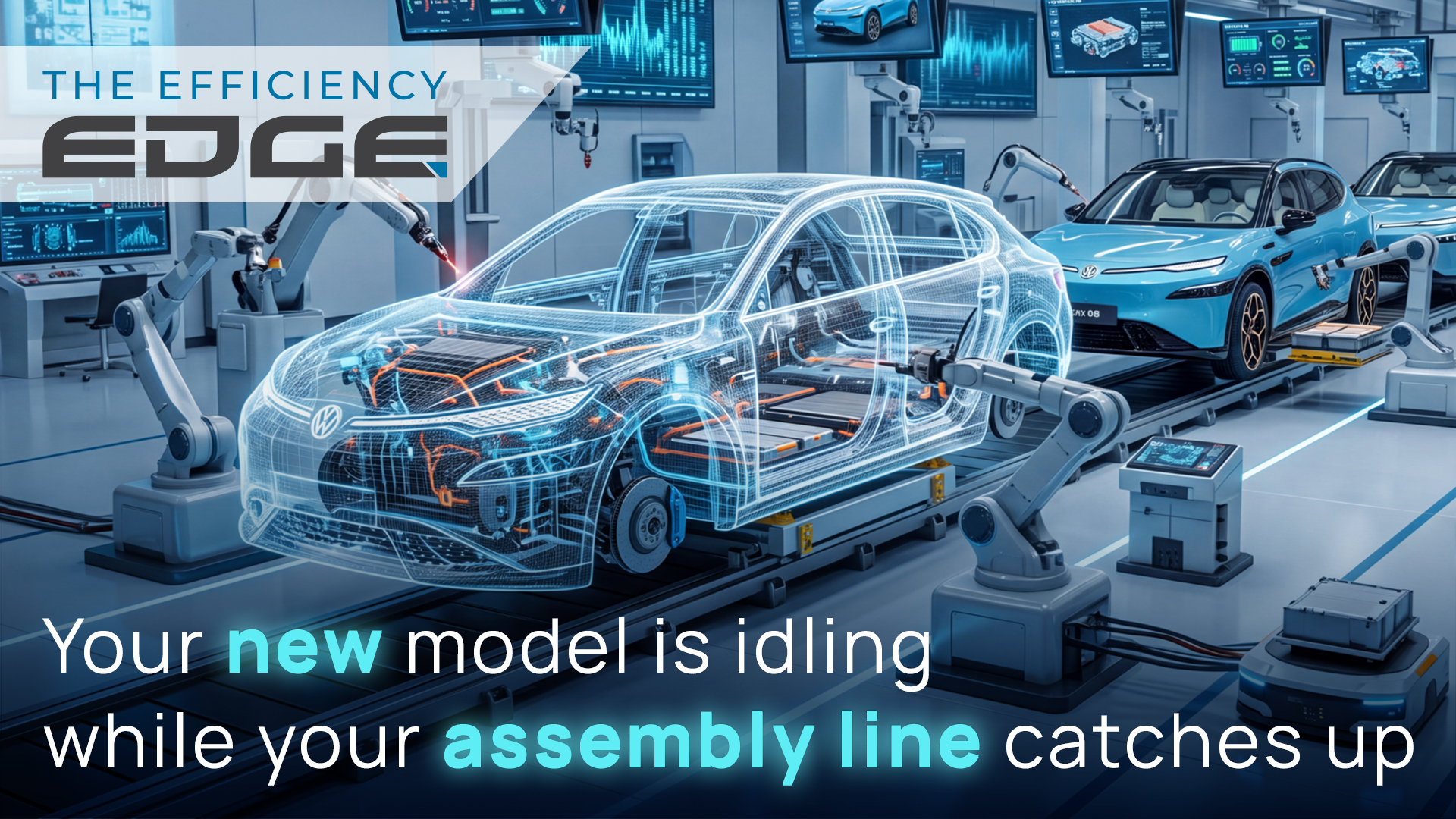
Volkswagen in China has halved its vehicle development time – from around 48 to 24 months. Following on from last month’s article, it’s another real-world example of an OEM rethinking its vehicles and being led by software-defined design.
The stumbling block is that the production line that assembles the car still takes up to 24 months to develop. So how do you build this same speed and flexibility into a fixed steel assembly system, making sure it’s able to absorb the constant changes that live product development brings? That’s what our Innovations Director, Yanesh Naidoo, delves into in this article.
Why did car development time halve but not assembly line build time?
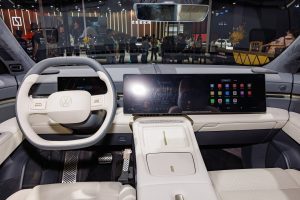
Volkswagen took its fully electric, full-size crossover SUV – the new ID.UNYX 08 – from a blank page to the start of production in China in 24 months. That’s a dramatic improvement, given that, according to McKinsey figures, a conventional programme runs for 40 to 50 months.
However, the time required to build the assembly line that manufactures the car has remained unchanged. Across our industry, it still takes up to 24 months to design, build, install and commission an assembly line. At Jendamark, on a good day, we push hard towards 12 to 18 months – but the timeline certainly hasn’t halved like the car. And this parallel timeline has implications for the overall speed to market.

How did making the car software-defined make it faster to develop?
The new vehicle became twice as fast to develop because the car itself became more flexible – not because everyone worked twice as hard.
Volkswagen’s own plan, published this year, is clear about the how:
These changes all reflect the underlying decisive move – to separate the software from the hardware. (This is exactly what Tesla did, as mentioned in our previous article.)
Because the car became software-defined, its behaviour can be changed and software improved without the whole machine being re-engineered. When the product is no longer a single, frozen block of hardware, you can develop it, change it and improve it far faster.
Why hasn’t assembly line building gotten faster?
On the other hand, the assembly line that builds the car didn’t become flexible – so it didn’t get faster.
It’s still, overwhelmingly, bespoke steel: designed and built for one product, and hard-wired to make it. Change the product and you have to change the steel. There is very little that is software-defined about it. While the car was being revolutionised, the assembly line went on taking the same 18 to 24 months it always has.
And that’s a problem that is about to escalate.
Why can’t you fix this by building the assembly line faster?
So, now the pressure is on companies like Jendamark to build our assembly lines faster. But the reality isn’t that simple.
When a car programme took 48 months and the assembly line took 24 to complete, we would start building the line around halfway through the development phase. By then the car’s design was fixed and the parts list had settled. We were building against something that was standing still.
Now the car programme takes 24 months and the assembly line still takes at least 18 months. So we have to start at month six – a quarter of the way in, with the car’s design still moving under our feet. We’re being asked to cut steel for a car that isn’t finished yet.
And you can’t fix that by working faster. Even if we halved our own build time tomorrow, we’d still be starting before the car was done. But the old way of working – finish the car, then build the assembly line to make it – is simply over. So, we had to ask ourselves how we address this to keep our business and our customers moving forward.
What are the benefits of a flexible, software-defined assembly line?
The logical answer is to give the assembly line the same treatment that the car got. Build flexibility into the line itself by making it software-defined. The set-up starts in the software rather than a hardwired steel foundation.
And that single change buys manufacturers three positive outcomes. You can:
Flexibility is what makes the assembly line faster to build in the first place – the very same mechanism that sped up the car.
How does an assembly line operating system work?
None of this is theory for us. It’s shifting the very foundation of our business too. But we are convinced, having built more than 3 500 automated assembly systems over the last three decades, that the future of manufacturing cannot be built on a fixed set of machines wired together.
It’s going to be built on an operating system that allows you to plan, run and prove the work, and make adjustments as you need to. The goal is responsiveness – when the product changes, you change the software, not the steel.
For us, what this looks like in practice, is our ODIN Workstation operating system, that is being integrated into new and existing assembly lines for our customers. It’s one of the ways we’ve helped customers like ZF manage complex, multi-variant production (check out the case study here).
At the rate the industry and tech is changing, software-defined systems will be the only kind that can keep up.
What does this mean for carmakers now?
Volkswagen has shown other legacy OEMs that a car can be made flexible, and that its flexibility is what makes it so much faster to develop. That’s a real achievement.
But they’ve only finished half the job. The car is flexible but the assembly line that builds it is not – and that is the next revolution waiting to happen.
Watch a full walk-through of a software-defined line on a real production floor: