
When it comes to your production line, do you understand the difference between automation and autonomy – and is it an either/or choice for manufacturers? There is room for both, writes Yanesh Naidoo.
Simply put, automation is doing the work without a person. Someone makes the decision in advance, and the machine repeats it, in the same way, every cycle.
Autonomy is making the call without a person. When the conditions change, the line itself works out what to do about it.
Almost every plant I walk into has bought a great deal of the first and almost none of the second. Then management adds an AI layer on top and wonders why the answers come back thin. (Spoiler alert: It’s because they haven’t built a data-driven, digital foundation to make it work.)
Ask anyone in our industry whether their line is automated and you will get a confident yes, usually with an impressive tour to prove it. Robots, presses, bolting tools, conveyors, a fence around the lot of it.
Then ask who decides what to do when something on that line changes. The answer is usually two or three key people, and it usually happens when they are least available, affecting the smooth flow of production.
When deciding what’s best for your production set-up, manufacturing customers tend to assume that automation versus autonomy is an either/or choice.
Automation is often top of mind because it is visible. It demands capital investment, a fence around industrial robots, and a regular maintenance bill. It is fixed for the process and station it was built for.
Autonomy is an unseen presence on the factory floor that needs no fence and demands lower capital investment. It reads what every station recorded, works across the whole line at once, and gets better every time the line runs.
In our experience, having built production lines for over three decades, you need both. Automation without autonomy is a fast machine that cannot adapt. Autonomy without automation is good advice that nobody acts on. A model that knows the torque is drifting is worth nothing if the tool it is advising cannot be told to do anything about it.
Ask anyone what level of autonomy their car has and you get an answer in two seconds flat. They might not know that it is Level 2, for example, but will be able to list functionality like lane centring and adaptive cruise control and know that the driver still needs to have their eyes on the road and their hands on the wheel.
In the production environment, not many managers know what level their assembly line is at. Here, the six levels (0 to 5) of driving automation are a handy guide, as there are strong parallels between car and assembly line.
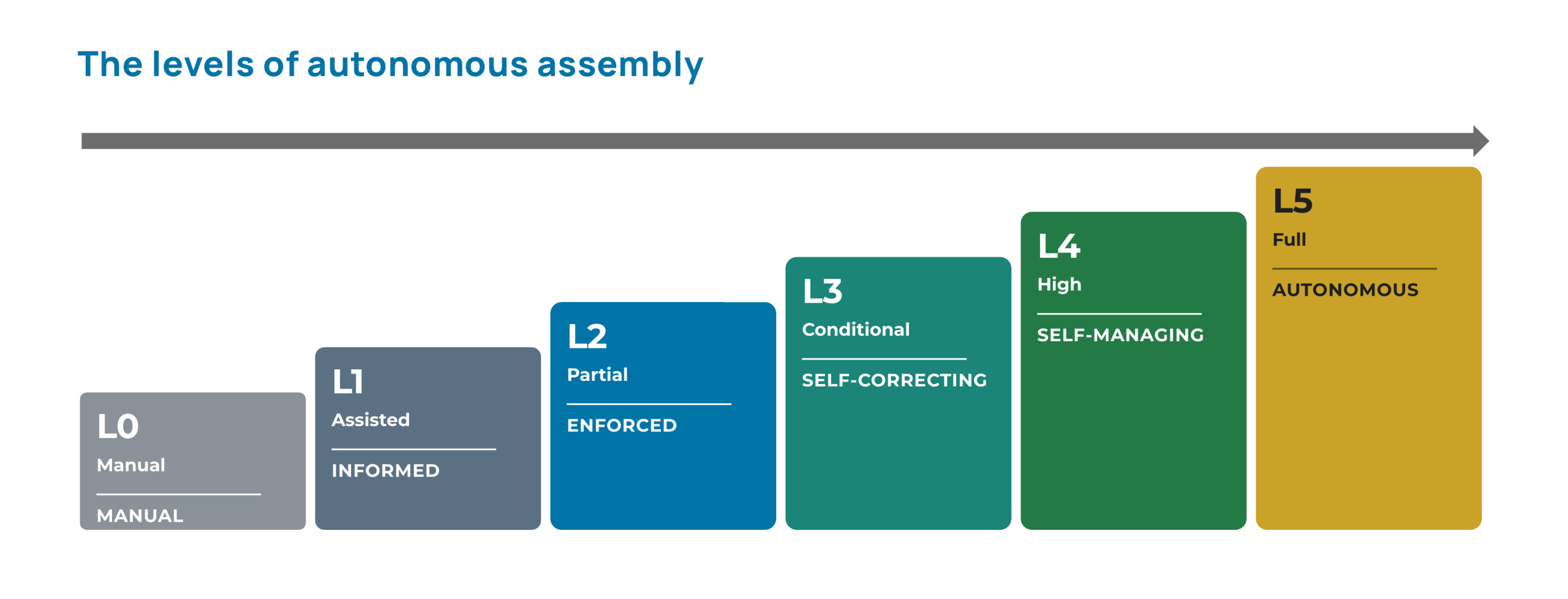
Like the car, what makes progress possible is not smarter equipment but the underlying assembly line architecture.
Here is what Level 1 looks like in practice at four stations on an actual line we built.
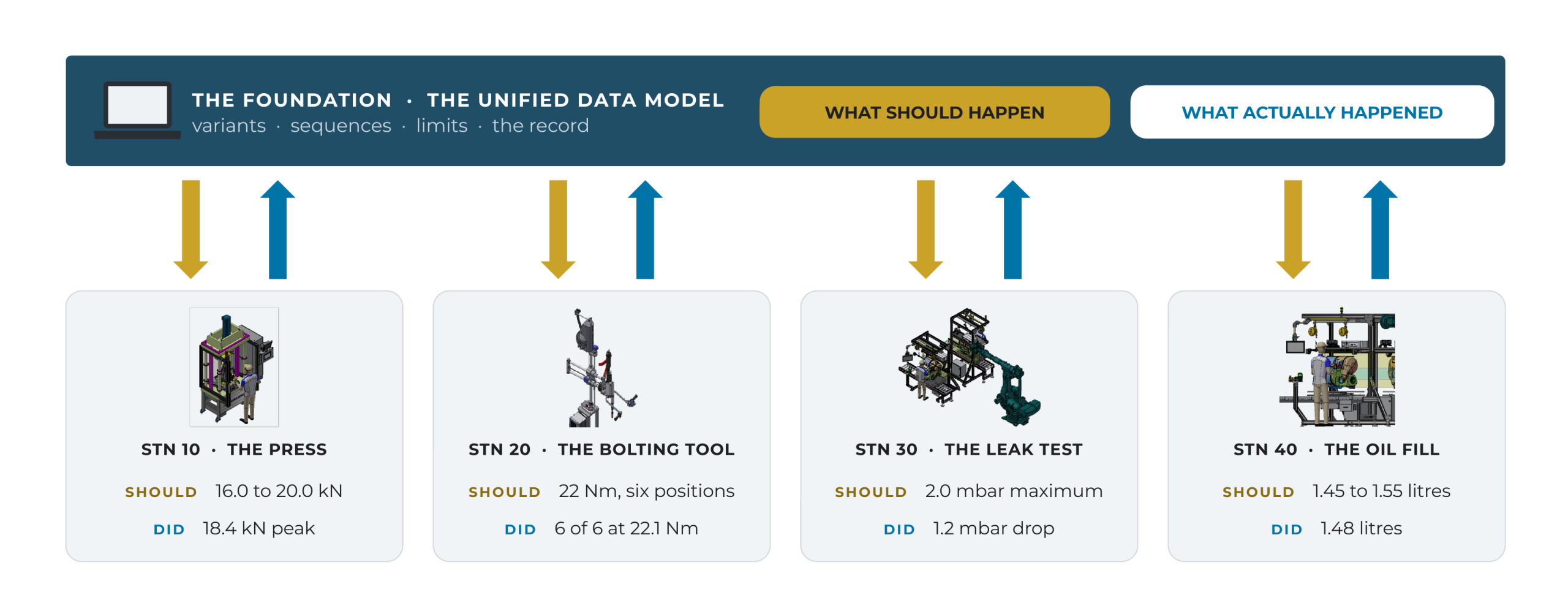
The instruction, or what should happen, goes down and the result, what actually happened, comes back up. Station 10 should press the bearing in between 16.0 and 20.0 kN, and it did, at 18.4 kN peak. Station 20 should tighten six bolts to 22 Nm, and it did, six of six at 22.1 Nm. Station 30 should hold under 2.0 mbar, and it dropped 1.2 in the leak test. Station 40 should fill 1.45 to 1.55 litres of oil, and it put in 1.48 litres.
None of that is new. The curve, the picture and the trace already exist inside a machine somewhere on your floor. Level 1 keeps that data in one place, against the part, along with who ran it and how long it took.
That is the unglamorous foundation, and every level above it is built on it. A model cannot reason about a line that never wrote anything down.
Let’s look at another example of a bolting tool used in multi-variant assembly. Variant A gets 22 Nm of torque and socket 4. Variant B gets 28 Nm and socket 7. They are not tightened the same way, and on most lines the person holding the tool is the one who has to know and apply that.
On an enforced line, the variant is read before the operator picks anything up. The right socket is called, and a poka-yoke stops the wrong one going in. The program loads itself. Every pass is counted, so where three are expected, two will not close the job. The screen shows the operator every position, pass or fail, while the job is still open.
While the tool could always do this, it never had something telling it which variant was in front of it.
At Level 3, the station fixes an incorrect action or stops there and then. Back to the car analogy, your vehicle has had similar reflexes for years. ABS has been deciding what the brakes actually do, many times a second, since 1978, while lane keep assist sees the drift and corrects the steering in the same moment.
On a station, the same applies. The controller runs the strategy for that bolt, the torque, the angle, the gradient and how many retries it is allowed. And the tool is not enabled until the camera says it is on the right bolt.
The operator cannot run the bolts out of order. Bolt 3 will not turn before bolt 2, not because somebody is watching, but because the tool will not spin because the vision system will not allow it to act.
Self-management is what takes things to the next level. You’re no longer just automating assembly, you’re now also automating the thinking.
Instead of reacting to a step that has gone wrong, the model watches the numbers the line has already produced and predicts potential problems.
A good example is a press drifting towards a failure that hasn’t happened yet. Every one of the parts has passed so far. None of them has failed. But the goal is to watch the trend in press force against the good curves that went before and to go after the cause when it starts heading in the wrong direction.
The same shape of model catches a measuring probe that was knocked loose, where eighty parts were built before anybody noticed. It catches a setting typed in wrong at the oil fill, while the unit is still open and can be corrected.
None of these scenarios needed a robot but every one was a decision a person used to make.
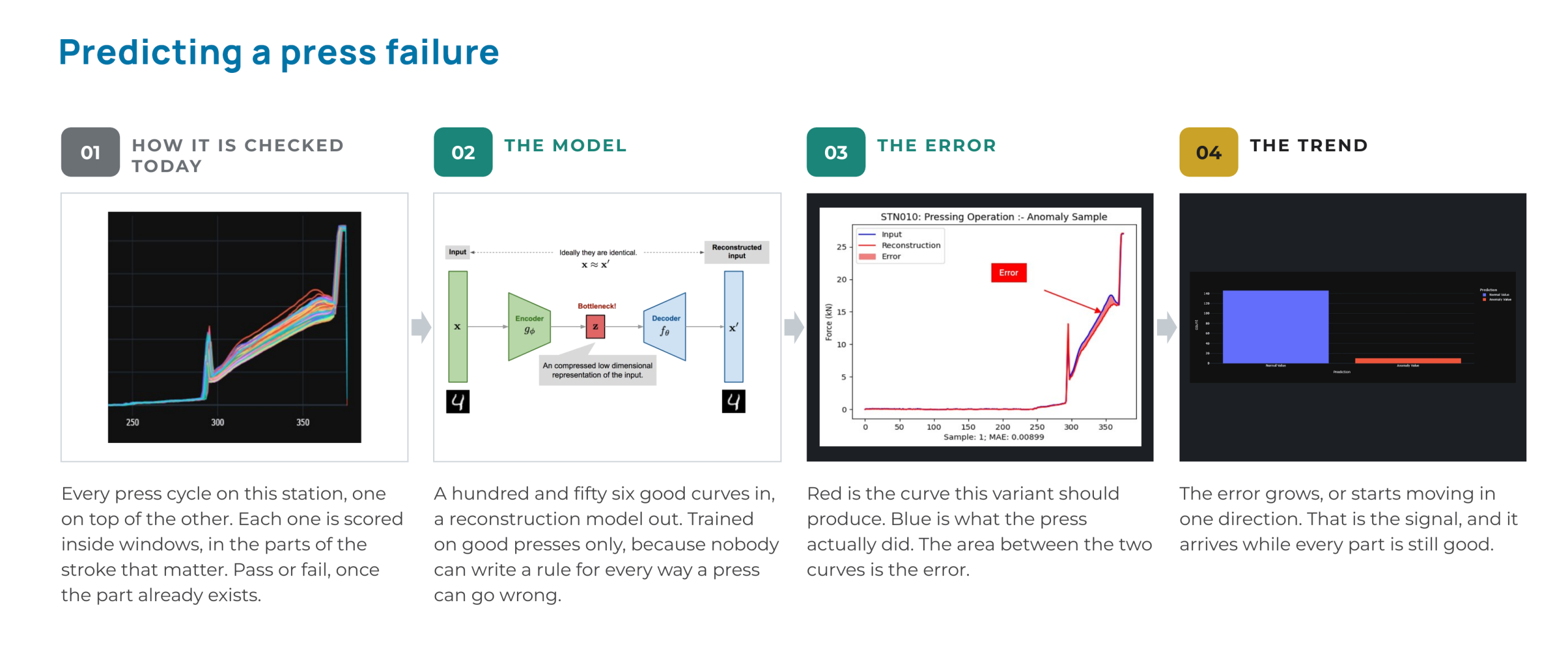
Remember the unified data model that creates your production record back at Level 1?
Once that record exists, the next step won’t be to add one big artificial intelligence. You get a lot of little models, each solving a single narrow problem, and each able to exist only because the data record exists. One watches press force deviation. One watches gauge drift. One watches bolt sequence and position.
What we are now building towards is a future AI agent that reads all of it at once – the machines, the little models and the humans. The goal is for it to suggest what to do, explain why in plain language and ask before it acts. Its success stands on how solidly the other levels are built.
Jendamark developed ODIN Workstation, an operating system for the assembly line rather than a layer on top of it: it plans the work, runs the work and proves the work, keeping a record of every torque, every curve, every scan, every retry, bound to the serial number.
Without a data-driven foundation such as this, every smart addition that a factory invests in stands on nothing.
So, it’s a worthwhile exercise for management to spend time working out which level your assembly line is currently at, and what the next level of development will require. Because the plants that can answer that are the ones that will be able to leverage whatever comes next.
This article is based on a lecture by Yanesh Naidoo at Oakland University. Watch the full presentation here.
Read more about ODIN Workstation here.